Image created with Microsoft Copilot
Young Europeans are often portrayed as politically disengaged, yet recent data paints a more nuanced picture. While many young people do vote, a significant number feel that elections alone don’t fully capture how they want to participate in shaping Europe’s future.
According to Eurobarometer findings, only 38% of young people consider voting the most effective way to make their voice heard, suggesting that today’s youth are looking for more flexible, creative, and continuous forms of engagement.
This shift doesn’t signal apathy, it signals evolution. Across Europe, young people are experimenting with new ways to influence institutions, policies, and public debate. The EU, in turn, has been expanding opportunities for youth participation beyond the ballot box.
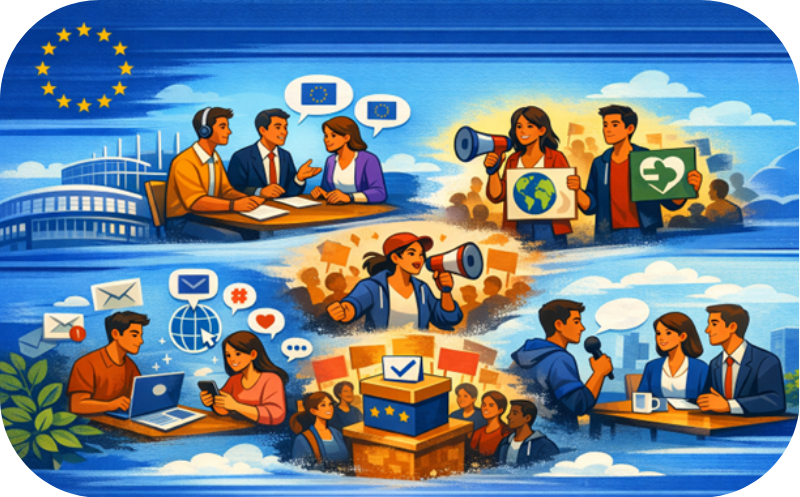
Below are five meaningful ways young people can shape the EU, even outside election periods.
The EU regularly invites young people to contribute ideas through structured dialogues and consultations such as the EU Youth Dialogue and the Conference on the Future of Europe. These initiatives allow youth to influence policy areas ranging from climate action to digital rights. For example, the EU Youth Dialogue has led to concrete recommendations on mental health and sustainability, later integrated into youth strategies at national level.
Thousands of young Europeans are active in organisations like European Youth Forum, AEGEE-Europe, and Youth for Climate, which advocate for democracy, equality, and environmental justice. Their involvement strengthens civic life and ensures that youth priorities, from social inclusion to green transition, are represented in EU debates. These networks also provide training and funding opportunities that empower young people to lead local initiatives with European impact.
Digital platforms have become powerful spaces for youth engagement. Movements such as Fridays for Future and #EUYouthGoals show how social media can mobilise thousands across borders. Young people use online petitions, email campaigns, and creative content to pressure decision-makers and raise awareness. The EU supports this through programmes like Digital Europe, which promote digital literacy and safe online participation.
Initiatives like Y Vote and Generation Climate Europe demonstrate how youth-driven campaigns can raise awareness and encourage political engagement. These movements have successfully influenced public debate on issues such as voting accessibility and climate policy. By leading advocacy efforts, young people show that democratic culture can thrive outside formal institutions through creativity, collaboration, and persistence.
Platforms such as Debating Europe and EU Youth Portal give young people the chance to question leaders, propose ideas, and influence political agendas. These spaces help bridge the gap between institutions and youth communities, making participation more accessible. Events like the European Youth Event (EYE) in Strasbourg bring together thousands of young people to discuss the EU’s future directly with policymakers.
Youth participation in Europe is changing and that’s a strength. While voting remains essential, young people are proving that democracy thrives when citizens engage in multiple ways: through activism, dialogue, creativity, and community action.
Projects like EUVideogames can intercept this change by “talking their language”: meeting young people where they already are in digital spaces, creative environments, and interactive learning contexts. Through educational games and participatory tools, the project helps youth understand how they can have an impact, recognise their rights and duties as citizens, and explore democratic values in a way that feels authentic and empowering.
By combining civic learning with play, EUVideogames supports a new generation of Europeans who see participation not as an obligation, but as an opportunity to shape the world around them every day.
References: