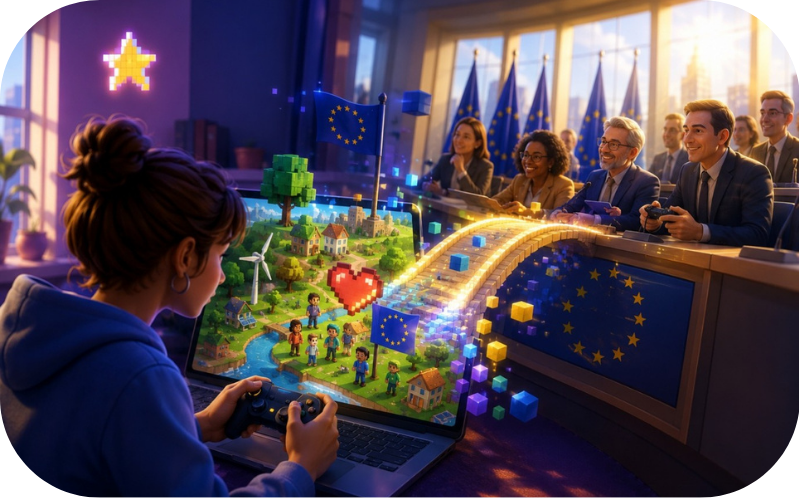
Image generated with ChatGPT
For as long as European citizens can remember, the standard path for active youth, who wanted to influence European Union policy or rules in any kind of way, was only one: attend a youth parliament, draft a position paper, or wait until election day to cast a ballot.
However, these times are changing and a quiet youth-led revolution is taking place all across Europe’s digital landscape. Armed with accessible, no-code game development tools and fuelled by European initiatives, young Europeans are bypassing traditional, bureaucratic avenues. They are coding their personal experiences, frustrations, and vision for a brighter future into playable interactive narratives and EU officials are starting to sit up, pick up controllers, and take notes.
By taking a policy that is hard to understand and turning it into simulations, these video games are transforming simple entertainment into a powerful tool for active European citizenship. And European youth actually become more interested in the life of the EU.
Over time, there have been many ways that people have tried to capture the attention of busy policymakers: protests, collecting signatures or asking them the hard questions directly during public meetings. In most cases, through these ways, it is hard to portray how the policies impact the everyday life of regular citizens. On the other side, video games compress the temporal and structural scales of political processes, allowing players to instantly experience the immediate and long-term consequences of systemic decisions (Brooks, 2024).
When a young person, who is interested in video games builds a resource management game using no-code platforms, they are not just making a game – it becomes a playable policy brief. An official EU report might give anyone reading it a good idea of the statistics or how everything should look like in theory, but playing a video game that was created by a young active person, gives anyone a much deeper understanding of what it is truly like to juggle real life and EU policies that sometimes were built on dreams.
This interactive way directly mirrors the Council of Europe’s Digital Citizenship Education (DCE) model, which applauds active participation through digital tools (Brooks, 2024). Such video games allow young people to practise citizenship, building the political and media literacy required to challenge or support institutional structures from the ground up.
Traditional Youth Advocacy | ───> | Outcome Profile |
Written Position Papers. | vs. | Gamified Youth Advocacy |
This difference is not coming from nowhere. It is backed by empirical research and institutional scaffolding aimed at empowering young people. Video games and gamified tools have a big effect in fostering crucial work-related and political-environmental skills among youth, directly preparing them to engage with complex, real-world governance (Hasanah, 2025). Some of the projects that make a difference:
The DEMOGAMES Initiative: Funded by the Erasmus+, it utilises game-based learning specifically to transfer knowledge about democratic education (Wegenast et al., 2018). By developing tools like the Democracy Game Box, the project introduces young citizens to abstract democratic norms and institutional processes, translating academic insights directly into non-formal youth work.
When youth-led games are presented at European youth summits or directly to Members of the European Parliament (MEPs), the dynamic of civic dialogue fundamentally changes.
Video games become a big part of learning how to become a bit more empathic. Some games are being designed by young migrants or youth living in marginalised socio-economic regions to allow policymakers a better understanding of what life looks like for an individual navigating complex legal, educational, or bureaucratic barriers (Brooks, 2024). When an official person who has decision-making power is forced to make choices designed by youth who actually live in that reality, games replace assumptions with empathy.
Furthermore, serious games provide youth with “transformative skills” – complex problem-solving, innovation capabilities, and systemic thinking (Hasanah, 2025). When young people show these video games to EU officials, they are demonstrating an understanding of policy trade-offs, instead of just asking for change.
“The Structural Impact: Games compress political timelines. A policy that takes ten years to play out in Brussels can be simulated in a 15-minute playthrough, giving both youth and officials immediate insight into systemic cause and effect.” |
As the EU Video Games ecosystem continues to grow, our goal is clear: to ensure that these video games that were created by young people in Europe don’t just stay on community servers hidden away, but are actually integrated into EU youth consultations.
By turning players into creators and policy makers into players, Europe is unlocking a more inclusive, dynamic, and deeply empathetic form of democratic participation. The next directive shaping the future of Europe might not come from a traditional boardroom – it might just be coded by an active young person.
References: