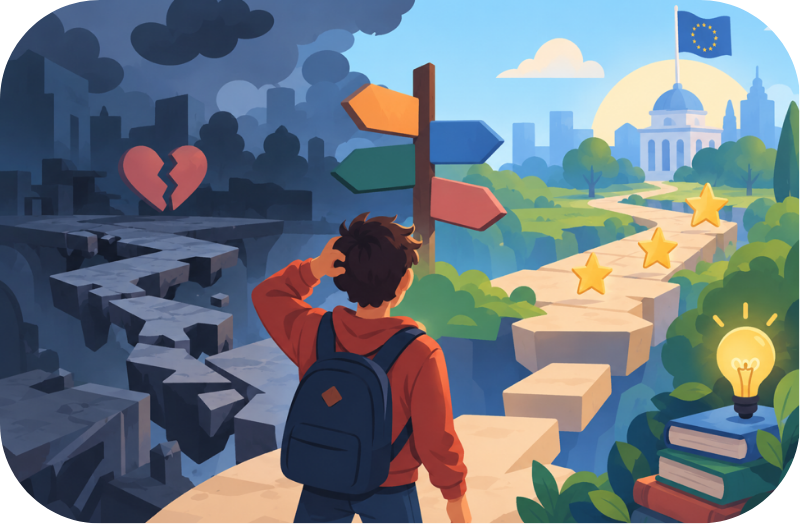
Image by ChatGPT
Why getting it wrong can be a good thing: learning through failure in video games
Nobody likes getting an answer wrong in front of a classroom. In a video game, however, failure feels completely different. You choose the wrong door, lose a challenge, make a decision that leads to an unexpected ending… and then you simply try again.
This is one of the most interesting things games can bring to education: they can make failure part of the learning experience rather than the end of it.
A safe place to make mistakes
Games give players something that is not always easy to create in real life: a safe space to experiment. But it is not failure itself that automatically produces learning. What matters is what happens afterwards: players see the consequences of their actions, receive feedback, think about what went wrong and have the opportunity to try a different strategy.
This process of trial and error is already at the heart of many video games. Some games are deliberately designed around repeated attempts: players fail, learn something about the game, adjust their strategy and try again. Roguelike games are a clear example, as failure and restarting are often central to the gameplay. Finding a better strategy becomes part of the challenge and can encourage creativity, persistence and experimentation, making eventual success particularly satisfying.
Other games encourage replay in a different way, offering multiple paths or endings depending on the player’s decisions. A choice that initially seems like a mistake can therefore become an opportunity to discover something new.
Seeing the consequences of your choices
Imagine a game in which you have to decide how a fictional town should spend its limited budget. Should more money go to public transport? Youth services? Green spaces? Housing?
There may not be one perfect answer. Instead, every decision can produce consequences. Players can see what happens, reconsider their priorities and try another approach. The learning comes not simply from making a “wrong” choice, but from observing its consequences, reflecting on them and deciding what to do differently next time.
Nothing disastrous happens if the first strategy does not work. But something important may happen in the player’s thinking.
From “wrong answer” to “what happens if…?” This can be particularly useful when exploring topics such as democracy and active citizenship.
Real democratic decisions are rarely simple multiple-choice questions with one obviously correct answer. They involve different interests, limited resources, compromises and consequences. A game can recreate some of this complexity on a small scale.
Instead of telling a young person “this is the correct decision”, a game can ask:
What would you do? And then: What happened because of your choice? Would you make the same decision again?
That second question is where much of the learning can happen. Players are encouraged to connect actions and consequences and to reconsider their decisions rather than simply being told whether an answer was right or wrong. This is particularly relevant to the original article’s democratic-decision example, where choices involve competing needs rather than one predetermined solution.
Failure encourages curiosity
Games can also make us curious about alternatives. If your first decision produces an unexpected result, you may want to replay the situation and choose differently. What happens if you cooperate with another character? What if you listen to another point of view? What if you change your priorities?
Playing the same situation more than once can reveal different consequences, perspectives and possible solutions. In this way, failure can encourage players to explore rather than simply search for the one “correct” answer.
This process turns players into active explorers rather than passive recipients of information. And importantly, making a mistake does not always need to result in a big red “WRONG!” message. Sometimes, experiencing the consequence of a decision and being given the opportunity to respond to it can provide much more meaningful feedback.
Designing better educational games
For youth workers and educators creating their own games, this leads to a useful design principle: do not be afraid to let players fail.
A meaningful educational game does not need to reward only the “correct” path. It can allow players to experiment, encounter consequences, reflect on what happened and reconsider their choices.
When designing a game, it can therefore be useful to think beyond:
“How will players win?” and also ask:
“What feedback will players receive when something goes wrong?”
“Will they understand the consequences of their choice?”
“Can they try another strategy?”
“What might they discover by replaying the situation?”
Designing failure in this way turns it from a simple negative outcome into an opportunity for feedback, reflection and experimentation.
Because sometimes the most interesting moment in a game comes just after you realise that your first idea did not work.
And you press Try Again.
Additional resources
If you are interested in why mistakes, experimentation and failure can support learning, here are a few resources to explore:
- Kapur, M. (2015). Learning from productive failure. Learning: Research and Practice, 1(1), 51–65. https://www.tandfonline.com/doi/full/10.1080/23735082.2015.1002195
A useful introduction to the idea of Productive Failure: giving learners space to explore and develop possible solutions before receiving direct instruction. - Kapur, M. (2014). Productive Failure in Learning Math. Cognitive Science, 38(5), 1008–1022. https://onlinelibrary.wiley.com/doi/10.1111/cogs.12107
Research comparing problem-solving before instruction with more traditional instruction. The studies found advantages for conceptual understanding and transfer when learners first attempted to solve problems themselves. - Kapur, M., & Bielaczyc, K. (2012). Designing for Productive Failure. The Journal of the Learning Sciences, 21(1), 45–83. https://www.tandfonline.com/doi/abs/10.1080/10508406.2011.591717
A deeper read for educators interested in how learning experiences can be deliberately designed so that initial struggle becomes part of the learning process.