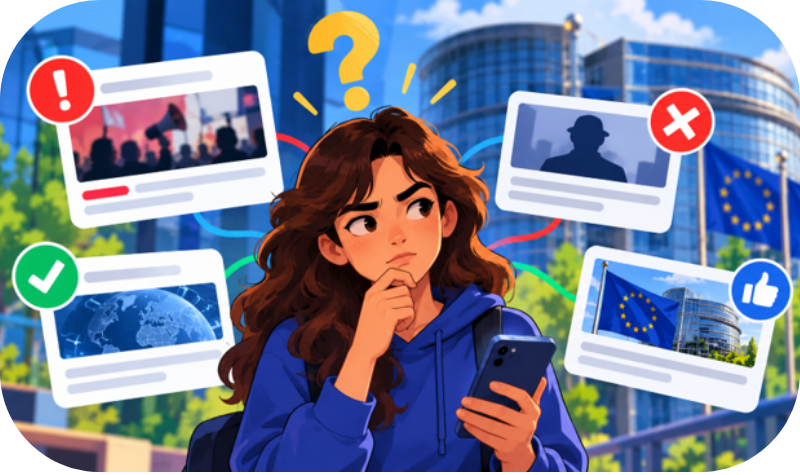
Image created with AI
Every day, we make decisions based on information. We read headlines, scroll through social media, watch videos, look at statistics and listen to other people’s opinions. Often, we have only a few seconds to decide whether something seems trustworthy.
But information is not always straightforward. A photograph can be real and still be presented in the wrong context. A statistic can be accurate but incomplete. A headline can exaggerate what an article actually says. A widely shared post may still come from an unreliable source.
Learning how to navigate this environment is an important part of media literacy. The European Commission describes media literacy as a set of skills, knowledge and understanding that allows people to use media effectively and safely, including the critical-thinking skills needed to exercise judgement, analyse complex realities and distinguish opinion from fact.
Games can offer an interesting way to practise those skills because they can turn abstract advice into decisions, consequences and reflection.
Most of us have heard advice such as “check the source”, “compare information”, “read beyond the headline” and “look for evidence”. The challenge is applying these principles when information is arriving quickly and different sources do not agree.
A game can turn that situation into an activity. Imagine that a player has to decide what should happen to a public space in a fictional town. Before making a choice, they receive a social media post, a short news report, a statistic and a message from another character. The sources do not completely agree.
The player can act immediately, search for another source, investigate where the statistic came from, or check whether an image really relates to the event being discussed. Instead of memorising a checklist, the player practises using it.
Media literacy is more useful when it moves beyond a simple choice between “real” and “fake”. Misleading information often works through missing context, selective presentation or exaggerated interpretation rather than through a completely invented claim.
For example, a post in the fictional game might say that a project will cost three times more than expected. The figure could come from an old version of the proposal. Another post might claim that almost everyone opposes the project, but the poll may have included only a small group. A photograph may be genuine, yet taken in another place or at another time.
A well-designed game can reward the quality of the player’s reasoning rather than one predetermined opinion. Did they check more than one source? Did they look for evidence? Did they notice what was missing? Were they willing to revise an initial judgement when new information appeared?
Games naturally create a cycle of information, choice, consequence and reflection. A player can make a weak decision, see what happens and try a different strategy without treating the mistake as the end of the learning process.
The same learning can happen through creating a game, not only playing one. Designing even a simple branching story forces the creator to think about how information is presented and how it influences a player’s choices.
What does the player know at the beginning? Which source appears trustworthy? What context is missing? When should new evidence become available? What happens if the player decides too quickly? Could two people reasonably interpret the same information differently?
These are game-design questions, but they are also media-literacy questions. They encourage creators to think about evidence, framing, credibility and uncertainty. The activity does not require advanced programming: a simple non-coding interactive story can already create a meaningful learning experience.
This theme connects with one part of the wider EU Video Games project. The project focuses broadly on democracy and participation, European citizenship and values, and digital skills, using game-based learning to make civic education more interactive and accessible.
Its current resources include content fiches on democracy and the EU, a technical guide for creating non-coding games and a content guide for integrating educational subjects into games. Also model games, templates, a game-creation toolbox are already available on the webiste. The project also plans tutorials and games created by young participants. Within that wider framework, media and information literacy – including the challenge of misinformation, can be explored as one possible civic and digital topic rather than as the project’s central subject.
This makes media literacy a useful example of how an abstract civic or digital competence can be translated into gameplay: not by telling players what to believe, but by giving them reasons to investigate before they decide.
Real information environments contain uncertainty. Two reliable sources can emphasise different aspects of the same issue. Evidence can be incomplete. New information can change what we know.
Games can represent this uncertainty especially well because information can appear gradually and decisions can develop over time. Instead of asking only “Is this true or false?”, players can be encouraged to ask better questions:
The aim is not to make players suspicious of everything. It is to help them build habits of checking, comparing and reconsidering before they act.
Games cannot decide what people should believe. But they can provide a safe environment in which people practise how to reach a more informed judgement.
Sometimes the smartest move is not to decide faster. It is to check first.
Further readings: