Image created with ChatGPT
Ever since the dawn of humanity, people have been asking themselves the same question: “What if?”. A simple question made to try and understand what would have happened if things went differently. What if a different decision had been made? What if someone had chosen cooperation instead of conflict? Throughout history, the choices of individuals and communities have shaped societies and the rights we enjoy today.
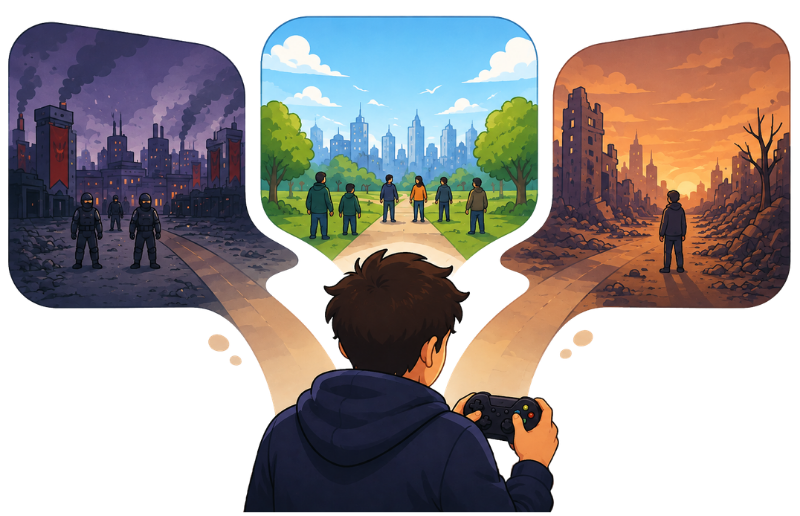
With adventure books and media like Marvel’s “What If…?” series, we can have a taste of different stories told with different outcomes. They are called alternate endings, and many video games explore this mechanic. Unlike books or films, video games place players at the centre of the story, requiring them to make decisions that directly influence the story and world.
Multiple-ending games provide safe environments for players to experiment with decision-making, reflect on ethical dilemmas and explore the consequences of their choices. They help develop important civic skills such as responsibility, accountability, morality, empathy, critical thinking and leadership, contributing to active citizenship and democratic participation.
Here are some examples of games with multiple endings:
In “Dishonored”, players control Corvo, a bodyguard wrongly accused of murdering the Empress he swore to protect. While pursuing the real murderer, aiming to avenge the Empress and bring her daughter to the throne, players complete missions either through violence or stealth and non-lethal solutions.
The game follows a morality system in which killing anyone is unnecessary and creativity and patience are needed to achieve the good ending without killing. However, there is the possibility of losing loved ones in the process, thus making each decision tense and highly impactful.
This game encourages players to reflect on the responsible use of power and on whether violence is always justified, even in the name of justice.
In a war between monsters and humans, the latter sealed the monsters underground, with the only way out being to gather 7 human souls. The protagonist, Frisk, falls into the underground and needs to fight their way out. The game involves 3 main endings.
Through these possibilities, the game promotes reflection on empathy and understanding different perspectives, exploring peaceful conflict resolution, compassion, fairness and inclusion and questioning prejudice before judging or acting against others.
In a medieval fantasy setting, Byleth, the protagonist, becomes a teacher at an academy, responsible for guiding the youth of one of 3 houses, with the story varying depending on the house the player chooses.
Following either the Empire, the Holy Kingdom or the Alliance, with different political visions, you will end up in war against the other two factions. It is up to the player to decide which ending they like most, with only one common theme: the unification of the nation and evolution towards democracy.
Rather than presenting a single “correct” choice, the game asks players to consider the strengths and weaknesses of different leadership systems. Every path requires difficult compromises and each ending reflects different priorities and values.
The game encourages discussion about different models of governance, different perspectives on leadership and responsibility, balancing tradition with reform and understanding that complex political issues rarely have perfect solutions but can affect an entire society and its people.
After a prank went wrong and 2 sisters died, their group of friends come back to the cabin in the mountains to honour their memory and becomes trapped by a deceitful killer and a horde of formerly human, cannibalistic monsters.
Throughout the story, the player controls different characters, making decisions that shape their relationships and their chances of survival. Although the overall story reaches the same conclusion, every character’s fate depends on the player’s actions. Quick decisions, trust between characters and willingness to help others all influence who dies and who lives.
In this narrative horror game, players are encouraged to reflect on responsibility and accountability, manage teamwork in difficult situations, navigate accountability, trust and communication and understand how selfish decisions can have life-changing consequences on many people.
These games, and many other multiple-ending games, are designed to test the limits of morality and the understanding that one person’s decisions can have lasting effects on individuals and communities. They encourage players to think beyond “winning” by inviting them to consider questions such as:
These reflections help players better understand that democratic societies are built upon discussion, responsibility, compromise and respect for others. By allowing them to explore different paths depending on their choices, these games promote critical thinking, moral reasoning and reflection.
These games provide valuable opportunities to discuss topics such as responsibility, cooperation, conflict resolution and ethical decision-making. Comparing different endings can spark meaningful conversations about fairness, justice, empathy and the impact of personal choices, helping learners connect fictional situations with real-world civic issues.
By encouraging active participation rather than passive observation, multiple-ending games support the development of key competences for democratic citizenship. This makes them powerful educational tools that serve the same goals as the EU VideoGames project resources, helping players explore European values such as democracy, human rights, responsibility and active civic engagement through interactive experiences in which young people make decisions that can shape the world’s future.
Further readings: